
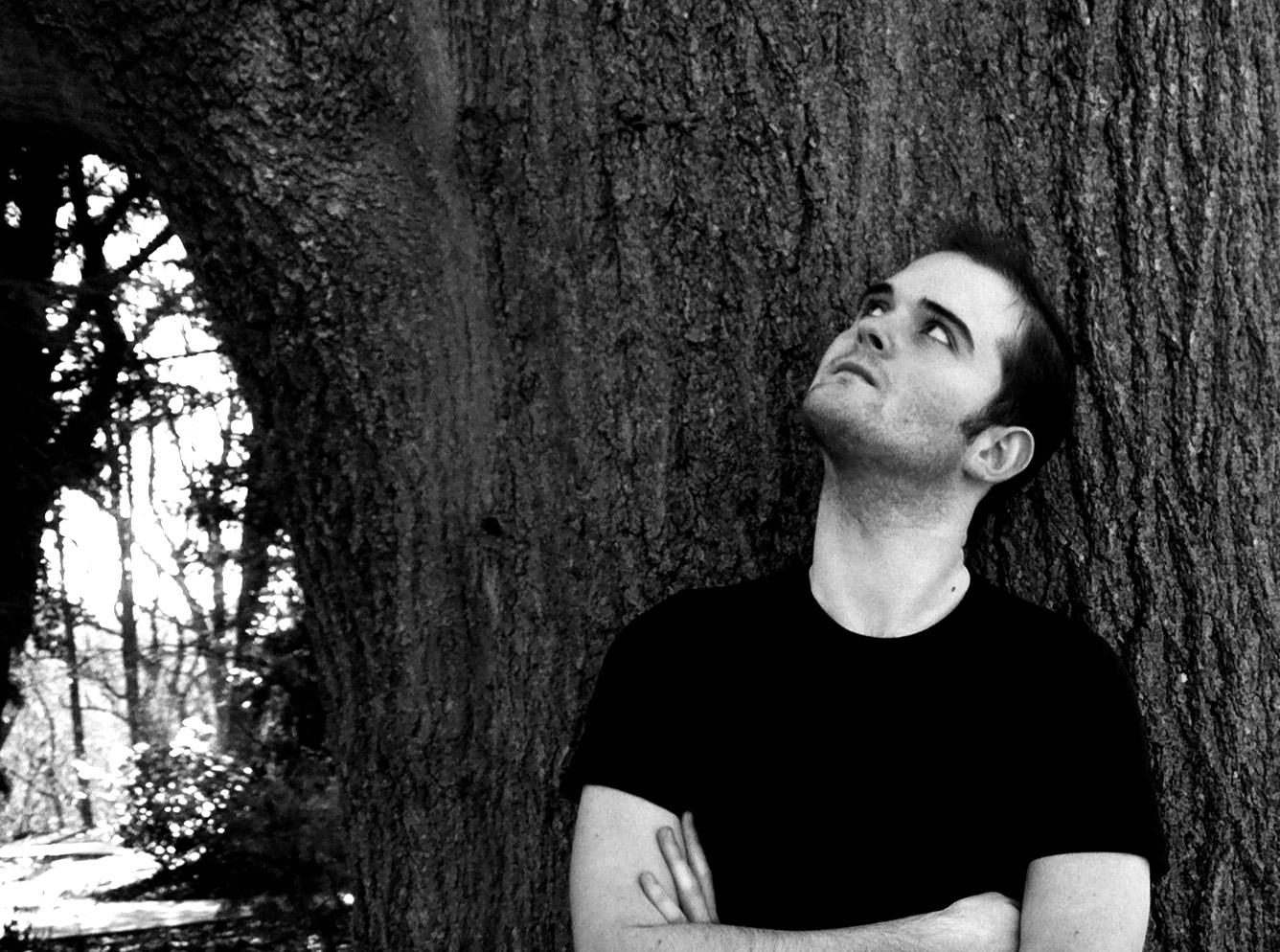
Interview: Asym Author Shawn Mihalik
Joshua Fields MillburnI first met Shawn Mihalik, a burgeoning young writer, in a coffeehouse in Pittsburgh, PA, just across the state line from his native Youngstown, OH, during one of The Minimalists’ book-tour stops. He had just turned 22. It was the first time we’d met face to face, but I’d already read his work.
You see, I’d been traversing the county in a Toyota Camry (our tour bus) with Nicodemus riding shotgun as we hopped from city to city, talking to readers, listening to their stories, and telling of our own journey.
Right before the tour, I had loaded my Kindle with three books—reading material for the road’s interstitial zones. As an indie author myself, I frequently support other indie authors’ work, and so one of those three books was Mihalik’s self-published poetry collection, The Final Days of Poetry, which I’d inadvertently stumbled upon via Twitter. After I added his book to my e-library, I tossed my Kindle in my bag and hit the road.
A few days later, we had some time to kill in Cleveland. The weather was oddly perfect, a rarity for Ohio: 73 degrees and cloudless under an early May sun. The lack of humidity made my armpits sing. With the prospect of a few hours in front of me, I found a park bench, parked my rump on its sun-kissed surface, and thumbed through my three new ebooks. The first book was nothing special, but the next book—Mihalik’s poetry collection—felt alive to me. I don’t read much poetry, but his poems seemed to capture what it means to be living in today’s terrifying, imperfect world. I read nearly the entire collection on that bench. It was clear to me that Mihalik was a gifted young writer—a young man with an old soul.
Flashforward a few days: Pittsburgh. Ryan and I sat in front of a modest crowd in a small room and exchanged stories. Shawn sat back and, as good writers do, he listened, taking in the scene unfolding around him. He asked good questions and participated in the discussion. We finished our meetup, exchanged hugs with the crowd, and headed to the next city.
When we got home, I stayed in contact with Shawn, reading some of his stories along the way. He was good and with each day he kept getting better. And so when we started Asymmetrical Press, I knew I wanted one of the online world’s most talented indie authors to be the first author on our roster. When I asked him to join the team as its first author, he agreed.
Coming Soon from Shawn Mihalik
This year, Asymmetrical Press is going to publish two books by Shawn Mihalik:
The Flute Player is a young-adult novella that adults will also love. For nearly ten years, young Oliver has begrudgingly accepted his position as the flute player of the peaceful village of Drommar—a responsibility thrust upon him after the previous flute player, and Oliver’s best friend, drowned in a tragic childhood accident. Now on the cusp of adulthood, a mysterious young woman enters Oliver’s life, and he begins to question the nature of his world and the importance of his place in it. Coming March 12, 2013 in print, ebook, and audiobook. 105 pages. YA fiction.
Brand Changing Day is the hilarious debut novel that everyone can relate to. In the world of the casual American chain restaurant, brand-changing day signifies the start of something new—new menu items are rolled out, logos are redesigned, service procedures are updated, and old uniforms are traded for hipper, darker, flashier styles. But for employees at The Grill in Youngstown, Ohio—including twenty-something server Scott Pelletier and forty-something general manager Geoffrey McCree—brand-changing day might be when everything changes. Forever. Coming spring 2013 in print, ebook, and audiobook. 240 pages. Literary fiction.
Mihalik also has two short pieces featured in Chapbook Volume 1.
A Conversation with Shawn Mihalik
JFM: As a fellow-Midwesterner, how do you think growing up in the Midwest has shaped your writing?
Shawn Mihalik: I think, more than anything, growing up in Youngstown, specifically, has shaped the way I see the world and the evolution of people and communities. It’s a city that, for the entirety of its existence, has had key involvement in some sort of industry: First the steel industry (which I wasn’t alive to experience), which then crashed, and then the auto industry, which also then started to crash but now looks like maybe things will be okay after all (various opinions regarding the government’s involvement not withstanding). People around here tend to view the city in terms of those successes and failures, and in doing so they think they live in such a small, boring place, and they miss the beautiful parks, the museums, the coffee and bake shops, the university with the brilliant professors and prominent guest-lecturers and excellent English department. But I was lucky in that I wasn’t born here—I moved from San Diego when I was seven—so I was able to see those things because I wasn’t so heavily influenced by the lore or history of the city. And that’s a theme in a lot of my writing—that the world is a much bigger and better place than we’re often lead to believe it is.
Last year you self-published a poetry collection. This year, through Asymmetrical Press, you’re publishing a novella, The Flute Player, and a novel, Brand-Changing Day. How was the writing process different for each project?
The writing process was very different for each project.
The poetry was something I’d written in bits and pieces over several years, not with the intention of putting it into a book, but just to capture specific people or events or emotions a few words at a time. So when I decided to put some of it in a collection, the writing had been done, almost what felt like effortlessly. The hard part for that, because I was self-publishing it, was the publishing itself.
The process for The Flute Player was entirely different, and honestly it’s almost completely a blur for me now. I wrote the first draft like five years ago just because I wanted to write something, decided to show it to a friend a few years later but didn’t want her to read an unedited first draft so rewrote it before giving it to her, and then rewrote it again before submitting it to Asymmetrical. It’s a very different story than when it first started.
And then Brand-Changing Day I wrote in response to a specific event and in a much shorter time compared to the other two books—about eight months. I also wrote the bulk of it while living in Pittsburgh.
You’re a young writer (22 at the time of this interview), but—
Twenty-three, actually, as of last week.
Well, happy (belated) birthday! Anyway, you write like you possess an old soul. You’ve cultivated a level of talent that many 40-year-old authors would give several digits from their non-use hand to be endowed with. When did you start writing? When did you realize you wanted to write full-time? How has your writing process evolved over the years?
I’ve always been attracted to art in all its forms. When I was very young, I wanted to be an artist—a painter or illustrator or sculptor. I wrote my first piece of fiction when I was maybe thirteen; it was a twenty-page Star Trek: Voyager fanfic, handwritten, that I called a novel and that no longer exists in any form so don’t ask. I didn’t become terribly serious about writing until high school, where I was encouraged to write. I joined the school newspaper (eventually becoming its editor) and read a lot of books, both of which strengthened my writing. I was also fortunate enough to have three or four amazing English teachers who were always stoking my writing fire.
After high school, I decided to pursue journalism as a career and majored in journalism with a focus in consumer technology (tech is still a big love of mine, to a fault, almost). A series of personal events lead me to leave Youngstown, though, and on a whim move to Pittsburgh, then back to Youngstown, and then back to Pittsburgh for a shorter time. I never did finish that journalism degree, but all the moving and exposure to people and various pieces of culture rekindled my love of writing fiction, which had taken a back seat to journalism for a few years, and that’s when I revisited The Flute Player.
The main character in The Flute Player, Oliver, is a young man on the cusp of adulthood. Oliver has, somewhat begrudgingly, been thrust into the most important roll in his community: he’s the new flute player. Where did you find Oliver as a character? Why was his story an important one to tell?
I found Oliver over the course of several years. When I first wrote The Flute Player five years ago, it was a very different story and Oliver a different character. It was this sappy love story and Oliver a whiny teenager. I was a whiny teenager, though, too. It wasn’t until I revisited the character as an adult that I realized that the story I’d been trying to write five years ago was the story of all young people trying to escape the roles forced upon them and the realization the freedom people seek can be found in all sorts of places, including in the roles they thought were holding them down, and also in art. This is Oliver.
For me, The Flute Player is a different kind of book: it straddles the fence between YA fiction and literary fiction As a reader of literary books, I thoroughly enjoyed this book. Was this your intent when you were writing it—to have it appeal equally to teens and adults?
When I wrote the first draft, it was for me. It was sappy and boring and terrible and in no way literary. But by the time I’d started working on the final draft, I was writing the book for a lot more people than just me, so yes, that was my intention.
What authors and books inspired you to write this kind of work?
C.S. Lewis Narnia series. Phillip Pullman’s The Golden Compass. Kafka’s The Metamorphosis. The Aeneid and The Odyssey (at one point The Flute Player was going be a fantastic sea voyage obviously inspired by these epics). Hamlet. Steinbeck’s Of Mice and Men. Even Ian Flemming’s Casino Royale (the first James Bond novel and a literary work in its own right). One of my biggest influence when writing the first draft was probably J.M. Barrie’s Peter Pan, still one of my favorite books.
What is your writing process like? How/when do you write?
I write in the morning, sometimes as early as 5 A.M. and sometimes as late as 9 A.M., after pouring my first cup of coffee. The goal is to take the cup of coffee to my desk and sit down and start writing, but often I’ll make it to the desk and instead of sitting, I’ll pick up my MacBook Air and take it back to bed with me, and do my writing there. I like to set a word count goal for myself, say around 1,500 words, but I almost never reach it (although when I’m getting close to the end of a particular piece I might surpass it, by a lot even) and so I’m trying to let go of the idea of setting word count goals I’ve seen no evidence of them helping my “productivity.” If I’m not actively writing something, then I start my morning the same way, but with reading instead of writing. Actually, there’s always reading, but if I’m writing, I write first and then read. I edit in coffee shops because if I didn’t I would get lonely.
I’d like to say I write everyday, and I do write every day when I’m actively working on something, but I tend to go at least a few days thinking about writing a particular thing before I start writing it. Like this short story I just finally started writing yesterday, but that I’ve been thinking about writing for the last two weeks.
This morning, I”m writing the answers to these questions. There will likely be no other writing for me today. This is hard enough.
What would you like readers to know about Shawn Mihalik?
He likes rock climbing and still reads comic books (and would love to write one) and is convinced that the book, as a collection of narrative or thoughts or ideas, digital or analogue or something else, will never die.